
Chapter 4: Sakura (Cherry Blossom)
It’s spring! Let’s smile at the blue sky!
The loveliness of this season may inspire you to sing the popular old song: “Sakura, sakura, yayoi no …”
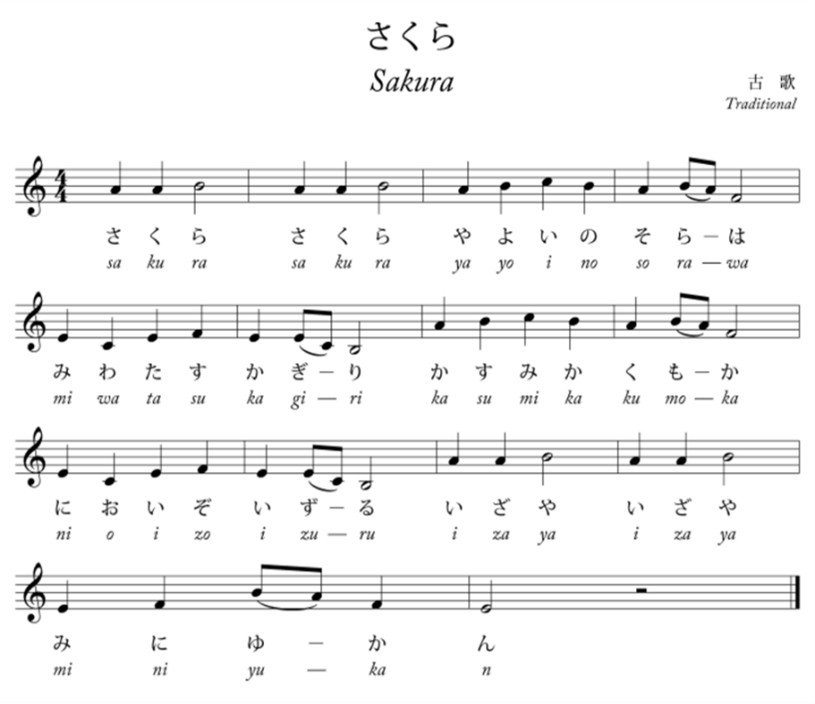
Music score of Sakura. (By Sakurambo)
In this season of flowering, I would like to share my thoughts on flowers, specifically the beloved Sakura-the cherry blossom. Not only are these beautiful blooms an integral part of Japanese life and culture in general, but also are featured prominently in dance, and have become a central theme in my life as well.
First, let us explore why Sakura is so deeply cherished in Japanese culture. Then, I will share what Sakura means to me personally, for these delicate flowers have come to embody the essence of my philosophy of dance.
The light pink color of the blossoms of Somei Yoshino, the predominant type of cherry tree found in Japan, suggests naivety and the beauty of adolescence. Its delicacy has found a home in Japanese culture, which tends to emphasize the subtle rather than the brash. The ephemeral quality of the flower, and the shortness of its peak, makes one’s heart race as one strives to catch sight of its beauty before it falls. In ancient Japanese mythology, Sakura was revered as a divinity, one which would bring good harvests. The name of this goddess, Sakuya, shares a root with the word Sakura.
Each spring, Japan unveils its Sakura Yoho (the cherry blossom forecast) which operates much like a weather report. It predicts when and where the iconic Sakura trees will bloom across the country, allowing people to plan their blossom-themed outings and celebrations with precision. So, the forecast plays a cherished role in orchestrating Japan’s vibrant springtime traditions from O-hanami (Flower viewing) to seasonal festivals.

Ohanami. (Photo from Ministry of Foreign Affairs of Japan)
O-hanami, is an outing to see Sakura and have picnics under the trees. It is one of the nation’s most well-known pastimes and has been one of the favorite ways to view flowers for centuries. O-hanami became popular among the nobility from the eleventh to the twelfth centuries before its popularity spread to commoners over the course of the Edo era, spanning the seventeenth,
eighteenth, and nineteenth centuries.
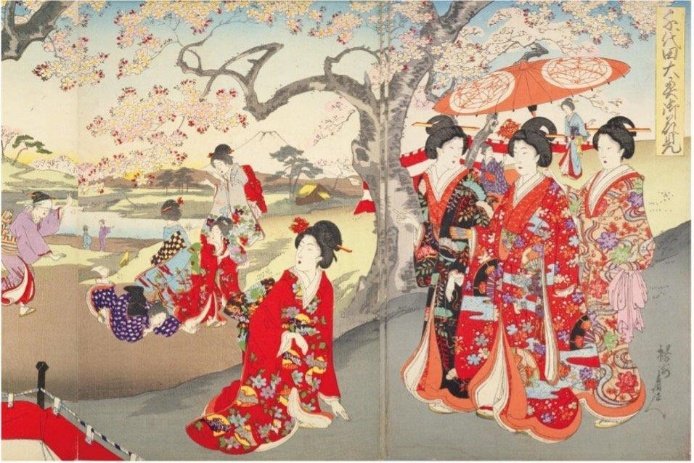
Ukiyoe of Ohanami in Edo Era. (“A Hanami at The Edo Castle Yoshu” by Hashimoto Chikanobu)
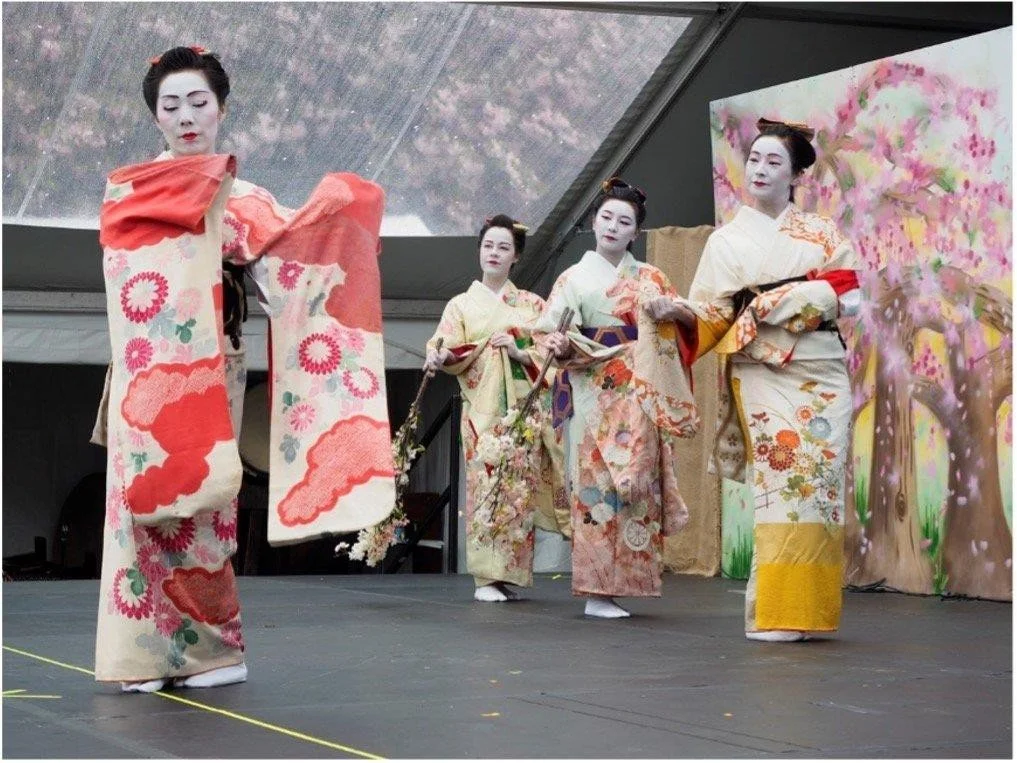
Photo: Tony Sahara at Sakura Matsuri at Brooklyn Botanic Garden
The Kabuki dance Sakura-gari, performed here by my dance company, depicts the same scene in Edo of people enjoying flowers by the Sumida River.
Ohanami calls for wagashi, or Sakura themed sweets, made only in the spring. I love them all, but they are too beautiful to eat!
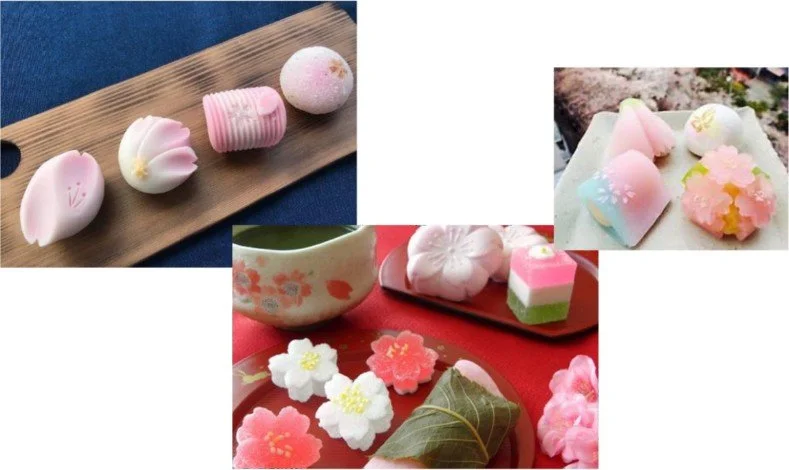
Photos from くらさか風月堂[1]
I recall having seen the Japanese film, Wonderful Life- titled in English After Life. The characters of the story have just deceased and must choose only one moment, the very best one, in their lives to take with them forever into paradise. An old woman chooses a time when she saw beautiful cherry blossoms falling, the flower petals fluttering and being blown by the spring breeze. It was a striking moment, and it reminded me how much the Japanese love and respect the beauty of flowers and how important they are in Japanese life.

Setsugekka 雪月花[2]
There is a Japanese word, Setsugekka, which is a portmanteau of the words for snow, moon, and flowers, and which has become a phrase in and of itself, referring to the inherent beauty found in nature. It is a fundamental concept that has fostered Japanese arts and culture. It is a metonym for beautiful scenery in nature and expresses the beauty of seasons: Winter by Snow, Fall by the Moon, Spring by Flowers.
As Isamu Kurita wrote in his Setsugekka no Kokoro (The Heart of Setsugekka), “Snow symbolizes impeccable beauty and purity, and the moon the immense expanse of the universe, while flowers symbolize phenomena of our existence that appear and disappear as conditioned by time and space.” In many Japanese dances as well as literature (particularly poetry), when flowers are referred to, they are implied to be Sakura. As Kurita eloquently says, the flower symbolizes impermanence.
In the 1970s, I was inspired by the writings of Zeami, who founded the Noh theater as it exists today in the 14th century.
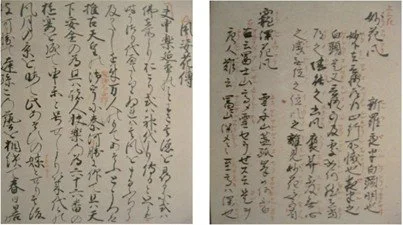
From Kadensho by Zeami The Taiyo: Noh, Kodansha International Tokyo, 1990
In his Fushi-kaden, also called Kadensho, he said, “The flower is fascinating because it withers and falls. So are the performing arts.” This is called Karon, or Flower Theory. The cherry blossom, more than any other flower, is best suited to illustrate this point as its life is so short.
Being a dancer, I interpret the flower as dance, rather than music or theater, which Zeami included in his art of “total theater, combining dance, music and drama.”
As soon as a dance is created, it disappears. As soon as it is born, it dies. You cannot capture it in your hand like a piece of art. That fleetingness is the very life of dance, which makes it more precious, wonderous, fascinating, and beautiful than other art forms.
I tell myself and my students, “Every time we dance, whether performing or practicing, it is the only and last time for us to dance, the only chance for us to do our best.”
The preciousness of each moment is found in our day-to-day lives: This morning’s beautiful sunlight is the only time it will be shared with a neighbor; the moon perfectly balanced on the spire of a building is a singular point in time that can never be repeated.
The moments that never return should be treasured, just as Zeami taught in the 14th century.
More than a decade ago, I came across the work of Kaneko Daiei, a Japanese philosopher of the 20th century. He says, “Flower Petals fall, but not the Flower.” This means that the true flower lives forever. A mentor’s teachings, a mother’s hug, kindness from a stranger, a dance performance, or an encounter with a beautiful sight—if it touched our hearts deeply and left us with a lifelong impact, a moment can remain within us forever. These true flowers of life are precious gifts, and I feel so fortunate and grateful to have been given them. Conversely, I often wonder, “What kind of flowers I can offer?” I can only hope my performances and my teaching could be a true flower for others. These flower theories are ones that I have treasured, and which have inspired me over the years.
In Zeami’s writings, one can find the word Omoshiroki. He says, “Because flower petals fall, it is Omoshiroki.” Omoshiroi, in the modern language, means interesting or sometimes amusing. However, during medieval Japan, it meant fascinating, unusual, or surprising.
In the 1980s I had a dear friend who used to say, “You have to be a surprise to people.” I didn’t understand at first, thinking, “Well, if you are a performing artist, yes of course, in appearing on stage you should be a surprise. But do you mean in daily life?” What he meant was a person’s presence when meeting people. Your first impression should be a surprise, one which warms people’s hearts and delights them.
It reminded me of Zeami’s word Omoshiroki. The way people find each other omoshiroki is one of the “true flowers” of life, as Kaneko Daiei taught us.
In the lyrics of the song “Itako Dejima,” found in the Kabuki play Fuji Musume, or Wisteria Maiden (originally staged in 1826), the following phrase stands out to me:
“There are many flowers in various colors, but there is no flower more beautiful than you are.”
When I dance it, I interpret it: Each person in the audience is a precious flower, and I try to meet their eyes, to tell them with mine that there is no flower more beautiful than they are. However, even when I am not dancing the Wisteria Maiden, I take the sentiment of the lyrics to the stage with me.
Sakura Matsuri, Rite of Spring
Sakura is the title of one of my dance company’s repertories inspired by the old song of the same name. It is the first dance I teach to children at my studio and at school workshops.
Over the years, I have choreographed many dances on the theme of Sakura and have danced at many spring celebrations centered around these lovely flowers.
Sakura Matsuri, the Cherry Blossom Festival, at Brooklyn Botanic Garden, was inaugurated in 1981. It is the oldest celebration honoring the beautiful flowers in New York City, and over the years the event attracted many people; in 2006, Over 50,000 people attended the event over the weekend. My company and I had been invited to perform from the first year onwards, but the festival was halted by the COVID-19 pandemic in early spring of 2020. It has not been held since. The cancellation was a big disappointment for us, for 2021 would have been our 40th year performing there. The annual Sakura Matsuri performance was what my company looked forward to every year as a rite of spring, having spent the fall and winter dedicated to rehearsing and preparing, not to speak of the audiences/visitors to the garden.
In the festival’s early days, we used to perform in the auditorium. In 1992 we began performing on the outdoor stage, for there were many who could not enter the auditorium and were fighting to get in! I must say that a performance on the “outdoor stage” is something extraordinary in performing classical dances.
The years we spent performing at the Sakura Matsuri were studded with memorable incidents. One time, a leg of the bench I sat on at the end of my dance Osen fell apart. I felt very bad, as it was brought to the Garden by the director from her antique collection. Another year, the gold screen that was serving as a backdrop fell on me while I was dancing! Of course, I kept going, and someone came onto the stage to pick it up.

Osen Photo by Katryn Sturgeon
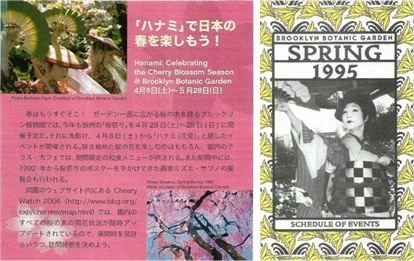
Flyers for Cherry Blossom Festival in Brooklyn Botanic Garden in 2006 and 1995
The date of the Sakura Matsuri was timed as best as the organizers could to coincide with the blooming of the cherry trees. The weather was always variable, and sometimes it would feel more like winter than spring. At one of our outdoor performances, it was so cold that my fingers were almost too frozen to tie the himo, or the tie that holds kimono closed, while changing costumes. They brought us small heaters in the dressing tent, but alas, the ceiling of the tent was open! Another year, it was so warm that the floor of the stage became as hot as a frying pan, and we had to wet our tabi in order to keep dancing. Unfortunately, this did little to help our poor hot feet!
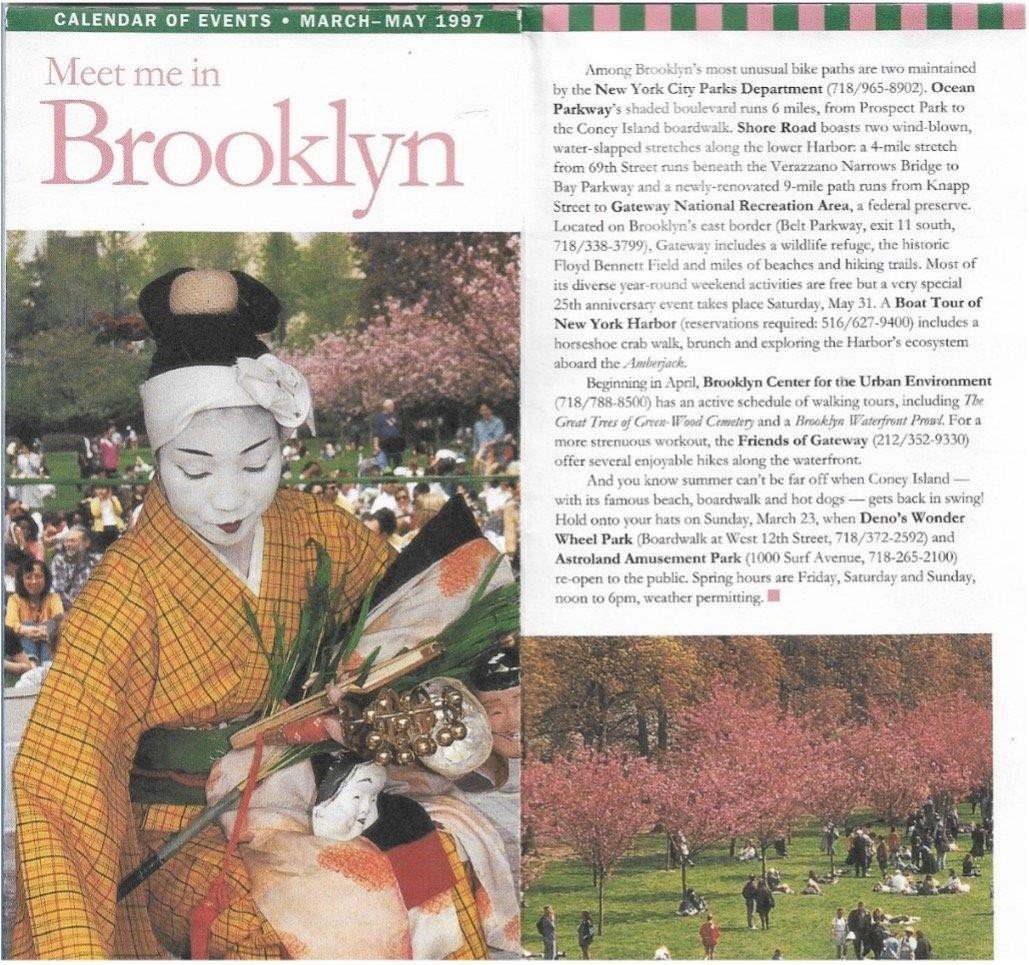
Brochure for Sakura Matsuri at the Brooklyn Botanic Garden from 1997
The 25th Anniversary Sakura Matsuri was a special one, as we had been one of the longstanding performers who had attended each festival without pause. I had been caring for my sick mother in Tokyo and had returned to New York for one week just for the Sakura Matsuri, to keep my commitment to the Garden. I spent the week rehearsing with my dancers, performed over two days, and headed immediately back to Tokyo.
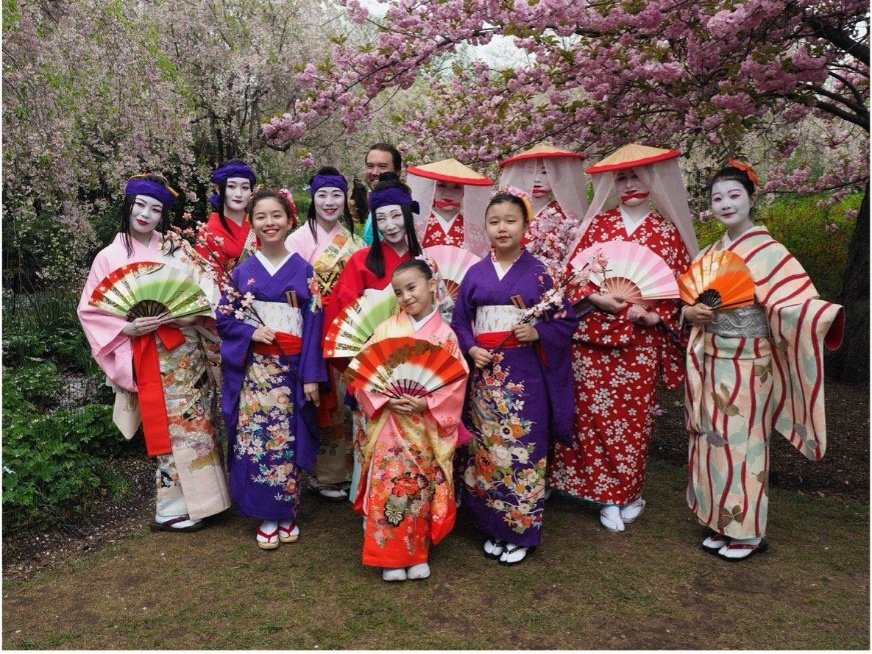
Sachiyo Ito and Company at the Sakura Matsuri Brooklyn Botanic Garden at the Herb Garden in 2023
Since 2021, we have been invited to perform for the garden’s spring Events series, which replaced the Sakura Matsuri. Our performance in 2021 was particularly memorable, for we danced with masks on our faces. The regular blue masks had to be turned over to the white side to match our white make-up!
There have been numerous other cherry blossom festivals I have danced at as well. My 1978 performance at the Newark Museum was the first of many cherry blossom festivals I performed in New Jersey, as well as other locations. I was pleased to have had an opportunity to introduce Kabuki dance to New Jersey audiences.
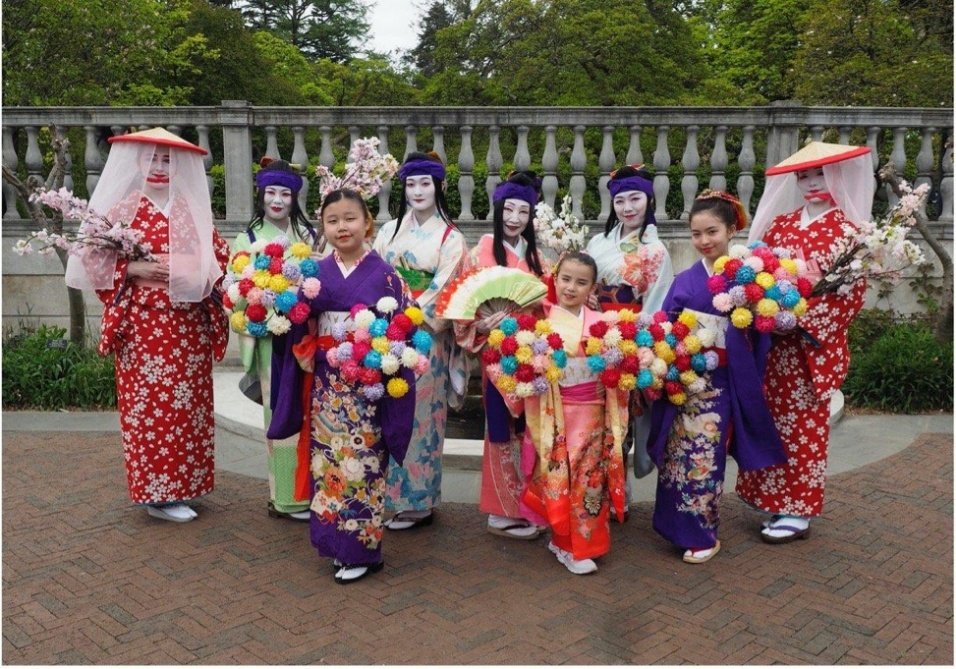
Sachiyo Ito and Company at the Bloomfest Cherry Blossom Festival, New Jersey, 2023
“The Cherry Blossom Dance, the Sakura, simply celebrates the nation’s favorite flower, while Fuji Ondo imagines the spirit of the wisteria tree, and Ayame Yukata is a rhapsodic personification of iris flowers that line the banks of a pond. banks of a pond.”
“Kabuki Puts Premium on Refinement, Restraint”
Valerie Sudol, Star Ledger, June 3, 1991
In 2006, I took four musicians and five dancers to perform at the Kennedy Center in Washington D.C. The event was held in conjunction with the National Cherry Blossom Festival. I must say it was a miracle we could perform on time because the train was nearly two hours late! We barely had rehearsal time before the curtain rose, but the performance went well after all. The next day was such a treat for us, for we could enjoy the cherry blossoms in full bloom around the Tidal Basin. We were very lucky to be able to see the flowers at the peak of their flowering. The National Cherry Blossom Festival lasts for several weeks each year, and by the time a friend of mine participated in the closing parade, the flowers were all gone.
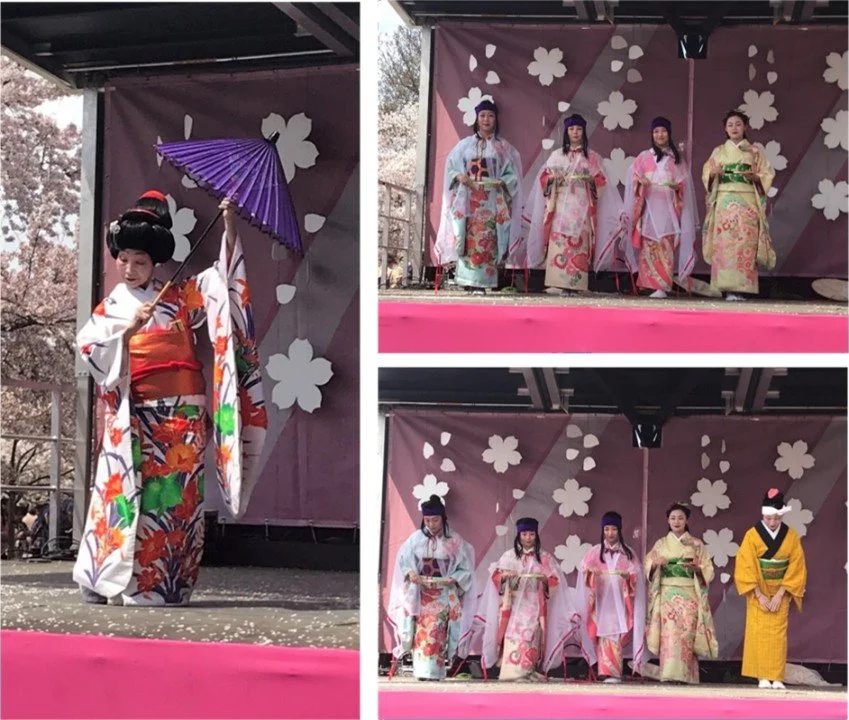
Tidal Basin ANA Welcome Stage Performance for the National Cherry Blossom Festival April 7, 2019
The luckiest performance in Washington, or at any other place, occurred in 2019. It was at the Tidal Basin Welcome Stage at the National Cherry Blossom Festival. As we danced, the flower petals were showering down all around us, almost as if they were dancing with us. The program included Sakura and Sakura-gari (Cherry Blossom hunting), two dances based on celebrating the beauty of cherry blossoms, and hunting for the most beautiful blooms. What a joy it was! It was the most blessed performance a Japanese dancer could ever have, I believe.
I would love to ask my readers: What is the most treasured moment in your lifetime? A meeting with someone? A meeting with a miracle of nature…such as Sakura?
“Like the delicate cherry blossoms that fade all too soon, the unforgettable work of Sachiyo Ito and Company came to an end as the applause died out and the lights dimmed for the final time. All that was left was a barren stage to remind us that art, life and beauty are to be fully enjoyed in the present moment before being released to eternity.”
“Sachiyo Ito and the Spirit of Sakura Matsuri”
Gerri Igarashi Yoshida, The New York NICHIBEI, May 23, 1985
[1] Instagram photo, n.d., accessed October 15, 2025, https://www.instagram.com/p/BhX7gjEgCFs/
[2] yasha.kachin, “Wallpaper,” Wallpapers.com, n.d., accessed October 15, 2025, yasha.kachin / Wallpapers.com / Yarachan, “Image (webjapan_mofajp),” Pixabay, n.d., accessed October 15, 2025, https://pixabay.com/photos/sakura-cheery-blossom-sky-spring-712312/
End of Chapter 4
©Sachiyo Ito All Rights Reserved